

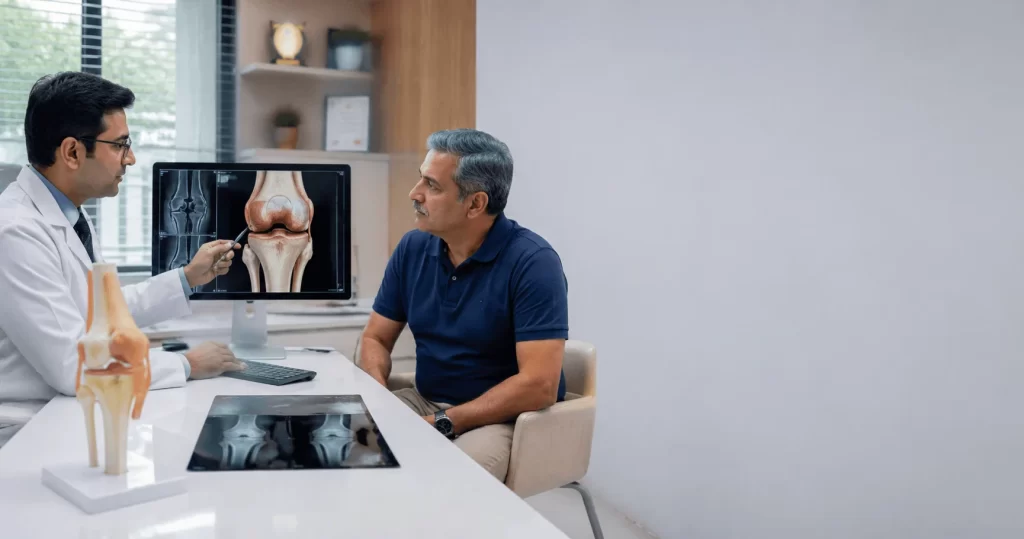
Knee Resurfacing: An Advanced Alternative for Joint Pain Relief

Knee Resurfacing: An Advanced Alternative for Joint Pain Relief featured image
Featured Image: Knee Resurfacing: An Advanced Alternative for Joint Pain Relief featured image

Living with chronic knee pain can affect every aspect of your daily life, whether it’s walking, climbing stairs, or even comfortably performing everyday activities. With the continued development of orthopedic technology, patients now have access to modern treatment options that can offer long-term relief and speed up recovery times. One of these unique options is a knee resurfacing surgery that is a minimally invasive alternative to conventional knee replacement methods.

If you are looking for a specialist in advanced orthopedic care and knee replacement in Punjab, then an experienced specialist like Dr. Manuj Wadhwa can guide you to the best treatment plan for your joint conditions.

What is knee resurfacing surgery?

Knee resurfacing surgery is a procedure that removes damaged portions of the knee joint, while preserving healthy bone and tissue. Knee resurfacing is different from total knee replacement because it only addresses the damaged parts of the knee, rather than replacing the entire joint. This helps maintain a more natural movement of the knee and allows patients to recover more quickly.

Patients with early to moderate arthritis, damaged cartilage, or localized knee pain that has not responded to medication, physiotherapy, or changes in lifestyle are frequently advised to undergo the surgery.

Benefits of Knee Resurfacing

Knee resurfacing is beneficial for suitable candidates in a number of ways:

  • Maintenance of healthy bone and ligaments
  • More rapid recovery than total knee replacement
  • Less post-operative pain
  • Greater knee mobility and flexibility
  • Small surgical incisions
  • More natural feeling in the knee joint

This is a procedure that many active people prefer because it can help them preserve better joint function and delay or avoid needing total knee replacement surgery.

Who is the right candidate?

Knee resurfacing is typically best for patients who:

  • Localized knee arthritis
  • Knee pain that won’t go away
  • They have limited cartilage damage.
  • You want to maintain an active lifestyle.
  • Are younger than the average knee replacement patient

However, patients with severe arthritis involving the whole knee joint may still need total knee replacement surgery. A thorough orthopedic assessment, incorporating X-rays and imaging studies, aids in establishing the most suitable treatment strategy.

Recovery After Surgery

Recovery from knee resurfacing is usually faster than traditional knee replacement surgeries. Most of the patients can walk with support soon after the surgery and slowly get back to normal activities with the help of physiotherapy and rehabilitation exercises.

Strength, flexibility and joint function over the long term will only be restored through proper rehabilitation. Most patients find significant pain relief and mobility improvement within just a few weeks when under expert care and guided recovery programs.

Knee Replacement in Punjab

With growing awareness about advanced orthopedic treatments, many patients now seek specialized solutions for joint problems and knee replacement in Punjab. Modern orthopedic centers offer advanced surgical techniques, minimally invasive procedures, and personalized rehabilitation programs to improve patient outcomes.

Elite Orthopaedics offers advanced orthopedic solutions, including knee resurfacing and joint replacement procedures, focused on faster recovery, improved mobility, and enhanced patient comfort. Under the expertise of Dr. Manuj Wadhwa, patients receive personalized treatment plans tailored to their individual joint conditions. 

Final Thoughts

Knee resurfacing surgery is becoming an increasingly popular option for patients seeking effective and less invasive treatment for chronic knee pain. By preserving healthy bone and restoring smooth joint movement, the procedure helps patients regain mobility and improve their quality of life.

If persistent knee pain is limiting your daily activities, consulting an experienced orthopedic specialist can help you explore whether knee resurfacing or knee replacement is the right solution for long-term relief.

Medical Disclaimer

The information provided in this article is for educational and informational purposes only and should not be considered a substitute for professional medical advice, diagnosis, or treatment. While Healthy Yoda strives to publish accurate, evidence-based, and up-to-date health content, medical information may change over time as new research becomes available.

Every individual has unique health conditions and treatment needs. Always consult a qualified orthopedic surgeon or healthcare professional before making any decisions regarding your health, medications, or surgical treatment. Do not ignore professional medical advice or delay seeking treatment based on information you have read on this website.

Healthy Yoda does not endorse or guarantee any specific treatment, procedure, healthcare provider, or medical outcome. Any opinions expressed by guest authors or healthcare professionals are their own and are intended solely for educational purposes. Reliance on any information provided by Healthy Yoda is strictly at your own risk.

If you are experiencing severe knee pain, sudden swelling, difficulty walking, or any medical emergency, seek immediate medical attention or contact your nearest healthcare facility without delay.

Frequently Asked Questions

Knee resurfacing surgery is an advanced orthopedic procedure that treats damaged areas of the knee joint while preserving as much healthy bone, cartilage, and surrounding tissue as possible. Unlike a total knee replacement, which replaces the entire knee joint, knee resurfacing focuses only on the affected portion of the knee. This approach helps maintain more natural knee movement, reduces surgical trauma, and often leads to a quicker recovery. Knee resurfacing surgery is commonly recommended for patients with localized knee arthritis, cartilage damage, or chronic knee pain that has not improved with medication, physiotherapy, or lifestyle modifications.

Knee resurfacing surgery is generally suitable for patients with early to moderate knee arthritis, localized cartilage damage, or persistent knee pain affecting only one part of the knee joint. It is often recommended for active individuals who wish to preserve their natural knee function and delay a total knee replacement. Candidates should have healthy ligaments, good bone quality, and limited joint damage. An orthopedic specialist will evaluate your condition through a physical examination, X-rays, and other imaging tests to determine whether knee resurfacing is the most appropriate treatment option.

Whether knee resurfacing is better than total knee replacement depends entirely on the patient’s condition. Knee resurfacing offers several advantages for eligible patients, including smaller incisions, preservation of healthy bone, faster recovery, less post-operative pain, and a more natural feeling during movement. However, patients with advanced arthritis affecting the entire knee joint may benefit more from a total knee replacement. The best treatment option should always be determined after a comprehensive orthopedic evaluation and diagnostic imaging performed by an experienced knee specialist.

Recovery after knee resurfacing surgery is typically faster than recovery from a total knee replacement. Most patients are encouraged to begin walking with support within a day or two after surgery and gradually return to routine daily activities over the following weeks. Physiotherapy plays an important role in restoring knee strength, flexibility, and mobility. While individual recovery times vary depending on age, overall health, and rehabilitation progress, many patients experience significant pain relief and improved joint function within four to eight weeks, with continued improvements over the following months.

Knee resurfacing surgery offers several important benefits for carefully selected patients. The procedure preserves healthy bone and ligaments, minimizes damage to surrounding tissues, reduces post-operative pain, and promotes faster recovery compared to traditional knee replacement surgery. Patients often experience improved knee mobility, better joint stability, and a more natural range of motion because much of the original knee structure remains intact. Additionally, knee resurfacing may help delay the need for a total knee replacement, making it an excellent option for younger and more active individuals with localized knee damage.

Yes, knee resurfacing is considered a minimally invasive orthopedic procedure because it involves treating only the damaged portion of the knee rather than replacing the entire joint. The surgery usually requires smaller incisions and preserves healthy bone, cartilage, and ligaments whenever possible. As a result, patients generally experience less blood loss, reduced pain, shorter hospital stays, and faster rehabilitation compared to traditional total knee replacement surgery. However, the exact surgical approach depends on the patient’s knee condition and the orthopedic surgeon’s assessment.

Choosing the best doctor for knee replacement in Punjab depends on several factors, including the surgeon’s experience, expertise in advanced orthopedic procedures, patient outcomes, and access to modern surgical technology. Patients should look for an orthopedic specialist who offers comprehensive diagnosis, personalized treatment planning, minimally invasive surgical options, and structured rehabilitation programs. Dr. Manuj Wadhwa is recognized for providing advanced orthopedic care, including knee resurfacing and knee replacement procedures, with treatment plans tailored to each patient’s specific condition and recovery goals.

The primary difference between knee resurfacing and total knee replacement lies in the amount of the knee joint that is replaced. Knee resurfacing removes and replaces only the damaged portion of the knee while preserving healthy bone, cartilage, and ligaments. In contrast, total knee replacement involves replacing the entire knee joint with artificial components. Knee resurfacing is generally recommended for patients with localized joint damage, whereas total knee replacement is often necessary for individuals with severe arthritis affecting the entire knee. An orthopedic evaluation helps determine which procedure is most appropriate based on the extent of joint damage.

The cost of knee resurfacing surgery in Punjab varies depending on several factors, including the patient’s medical condition, the complexity of the procedure, the hospital, the implant used, the surgeon’s expertise, and post-operative rehabilitation requirements. Since every patient’s treatment plan is different, the total cost can only be determined after a detailed orthopedic consultation and diagnostic evaluation. Patients are encouraged to consult an experienced orthopedic specialist to receive an accurate treatment plan, understand the expected expenses, and explore the most suitable surgical options for their condition.

Yes, knee resurfacing surgery can help delay the need for a total knee replacement in appropriately selected patients. By preserving healthy bone and treating only the damaged portion of the knee, the procedure restores joint function while maintaining the natural structure of the knee. This makes it particularly beneficial for younger or active individuals who wish to continue their daily activities with improved mobility. Although knee resurfacing is not suitable for every patient, it can provide long-lasting pain relief and postpone the need for complete knee replacement surgery when performed at the appropriate stage of joint disease.

Be the first to comment

Leave a Comment

Your email address will not be published. Required fields are marked *