

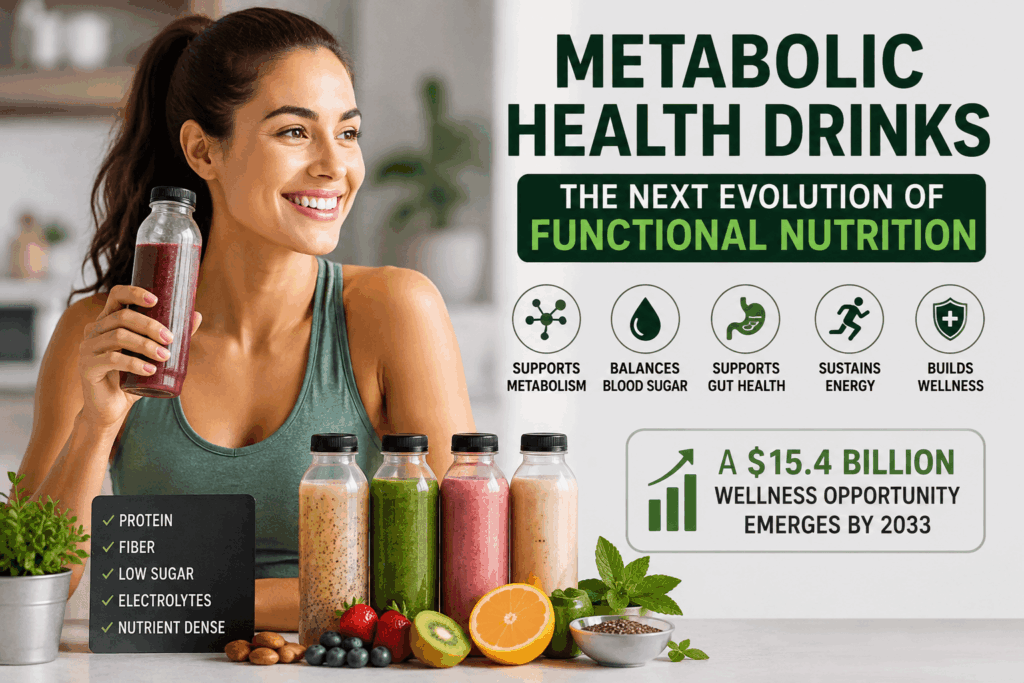
Why Metabolic Health Is Reshaping Everyday Nutrition
Metabolic health is becoming a practical nutrition priority rather than simply a clinical concept. Blood glucose regulation, insulin sensitivity, appetite control, lipid balance, energy metabolism, and gut function increasingly influence everyday dietary decisions. This shift creates a strong content niche for Healthy-Yoda, particularly around evidence-based nutrition, functional ingredients, beverage formulation, and practical consumer education.
How Metabolic Health Drinks Deliver Functional Nutrition
Metabolic health beverages represent an evolution of functional nutrition because one serving can combine several nutritional attributes in a convenient format. A carefully formulated drink may contain protein, dietary fiber, electrolytes, micronutrients, polyphenols, and controlled carbohydrate levels.
For example, a 330-mL beverage containing 15 g protein, 6 g fiber, 300 mg potassium, 100 mg magnesium, and 4 g added sugar has a significantly different nutritional profile from a conventional sweetened beverage containing 35 g sugar with minimal protein and fiber.
The $15.4 Billion Wellness Opportunity by 2033
The projected $15.4 billion wellness opportunity by 2033 highlights the commercial potential surrounding metabolic-oriented beverages. More importantly, the figure reflects changing consumer expectations about what a beverage should accomplish.
Research by Market Intelo highlights that, the global metabolic health drinks market reached $28.6 billion in 2025, with projections to expand to $55.3 billion by 2034, representing a steady compound annual growth rate (CAGR) of 8.3% throughout the forecast period. These figures indicate increasing commercial attention toward beverages positioned around metabolic wellness, nutrition density, and functional benefits.
Traditional soft drinks primarily deliver flavor and energy. Functional beverages increasingly aim to deliver hydration, protein, fiber, electrolytes, or other nutritional benefits. Metabolic health drinks occupy an intersection between these categories by emphasizing nutrient density while limiting unnecessary sugar.
This positioning can support several consumption occasions, including breakfast, office snacking, post-workout nutrition, commuting, travel, and convenient meal accompaniment. The strongest products will need to combine nutritional credibility with taste, affordability, convenience, and repeat-use potential.
The Science Behind Metabolic Drink Formulation
This creates a considerably different energy distribution compared with a beverage containing 35 g sugar, which alone contributes approximately 140 calories. The comparison demonstrates why formulation can influence both nutritional density and consumer perception.
However, nutrition cannot be judged from one ingredient. Total carbohydrate, serving size, sodium, fat quality, protein source, fiber type, micronutrient content, and overall dietary context must also be considered.
Why Fiber Matters for Metabolic Nutrition
Fiber is one of the most important ingredients for metabolic-focused formulations. WHO guidance recommends at least 25 g of naturally occurring dietary fiber daily for people older than 10 years.
Nevertheless, high-fiber formulations present technical challenges. Soluble fibers can increase viscosity, while certain ingredients may cause gastrointestinal discomfort when consumed in large quantities. Manufacturers must balance fiber concentration with solubility, mouthfeel, flavor, stability, and consumer tolerance.
Protein’s Role in Satiety and Nutrient Density
Protein adds another important dimension to metabolic beverage design. A serving containing 15–25 g protein can substantially increase the nutritional density of a beverage compared with conventional drinks that provide little or no protein.
Protein sources also affect formulation performance. Whey and milk proteins provide different textures and amino-acid profiles compared with soy, pea, rice, or blended plant proteins. A 20-g protein formulation also requires attention to sedimentation, solubility, heat stability, viscosity, and flavor masking.
For general consumers, they can complement meals or structured snacks. However, protein drinks should not automatically be treated as meal replacements because overall dietary adequacy depends on a broader range of nutrients and foods.
Sugar Reduction as a Core Formulation Strategy
Sugar management may become one of the most important characteristics of metabolic health drinks. WHO recommends limiting free sugars to less than 10% of total energy intake and suggests that reducing intake below 5% may provide additional benefits.
For a 2,000-calorie diet, 10% equals approximately 200 calories, or 50 g of sugar. The 5% level corresponds to approximately 100 calories, or 25 g. A beverage containing 20 g free sugar therefore uses 40% of the 50-g level in a single serving.
Reducing unnecessary sugar can therefore significantly change the nutritional profile of frequently consumed beverages. Formulators may use naturally occurring sweetness, lower-sugar fruit components, high-intensity sweeteners, or other approaches while maintaining acceptable taste.
Key Nutritional Metrics for Metabolic Health Drinks
| Formulation Metric | Practical Example | Nutritional Purpose |
|---|---|---|
| Serving size | 330 mL | Convenient daily format |
| Protein | 15 g | Supports protein density |
| Fiber | 5–8 g | Supports daily fiber intake |
| Added sugar | ≤5 g | Limits unnecessary sugar |
| Potassium | 300 mg | Supports electrolyte positioning |
| Magnesium | 100 mg | Adds micronutrient value |
These figures represent an illustrative formulation framework rather than a universal nutritional prescription. The optimal composition depends on the intended consumer, product category, regulatory requirements, ingredient interactions, and overall dietary positioning.
Beyond Macronutrients: Botanicals, Polyphenols, and Electrolytes
Metabolic beverage development is also moving beyond protein, carbohydrates, and fiber. Ingredients such as berries, cocoa, tea extracts, ginger, cinnamon, and other botanical components are attracting attention because they contain bioactive compounds.
Polyphenols are particularly relevant to functional nutrition research because they are associated with antioxidant and other biological activities. Prebiotic fibers can also support products positioned around the gut-metabolism relationship.
Electrolytes provide another formulation pathway. Potassium and magnesium can contribute to electrolyte functionality, but their inclusion should be based on scientifically appropriate quantities rather than simply being used as label decoration.
Building a Stacked-Nutrition Beverage Formula
A stacked-nutrition beverage combines several nutritional attributes within one serving. For example, a formulation could provide 15 g protein, 6 g fiber, 3 g unsaturated fat, 300 mg potassium, 100 mg magnesium, and less than 5 g added sugar.
Such a profile addresses multiple nutritional priorities simultaneously. Nevertheless, stacking ingredients should not become an excuse for excessive complexity. A product containing 20 functional ingredients may appear scientifically advanced but can become difficult for consumers to understand.
Effective formulation should prioritize meaningful ingredients at relevant quantities rather than creating a long label designed primarily for marketing appeal.
Why Metabolic Health Requires a Whole-Lifestyle Approach
Metabolic health is systemic and cannot be reduced to one beverage. Sleep quality, physical activity, dietary patterns, energy balance, stress, meal composition, and overall food quality can all influence health outcomes.
For Healthy-Yoda, this creates an opportunity to explain functional beverages within a broader nutrition framework. A metabolic drink should complement vegetables, legumes, fruits, whole grains, nuts, seeds, and other nutrient-dense foods rather than replace dietary diversity.
How Consumers Can Read Metabolic Drink Labels
Label literacy is becoming increasingly important as functional beverages become more sophisticated. Consumers should compare serving size, calories, protein, fiber, total carbohydrate, added sugar, sodium, and micronutrient levels.
The key is to evaluate measurable nutrition rather than relying solely on front-of-package claims.
Technical Challenges in Functional Beverage Production
Manufacturers must ensure that nutritional functionality survives processing and storage. Heat treatment can influence sensitive compounds, proteins may precipitate, minerals can alter flavor, and fibers can increase viscosity.
Botanical ingredients may introduce bitterness or color instability. Oxygen exposure can affect sensitive compounds, while pH can influence protein stability and microbial control. Packaging materials must also be compatible with the beverage throughout its intended shelf life.
Consequently, successful product development requires laboratory testing, sensory evaluation, stability studies, microbial validation, and appropriate regulatory review.
Ready-to-Drink Formats and Emerging Consumption Occasions
Convenience remains a major advantage of beverages. Ready-to-drink products in the 250–500 mL range can fit office, gym, commuting, and travel occasions. Powdered concentrates can reduce transportation weight and allow consumers to customize serving volume.
Refrigerated fermented beverages may appeal to consumers interested in digestive and gut-focused nutrition, while shelf-stable protein-fiber drinks can emphasize convenience and satiety.
These formats allow manufacturers to target different consumer needs without relying on a single universal formulation.
What the Future Holds for Metabolic Health Beverages
The $15.4 billion projection by 2033 signals substantial wellness potential, but long-term success will depend on more than financial opportunity. Products must achieve a difficult balance between nutrition, taste, affordability, convenience, stability, and scientific credibility.
Formulations providing approximately 10–20 g protein, 4–8 g fiber, low added sugar, useful micronutrients, and realistic serving sizes could create a measurable nutritional proposition. The strongest brands will likely differentiate themselves through transparent labels and evidence-supported claims.
Personalization could become another important direction. Future beverages may be designed around activity levels, dietary preferences, age-related nutritional needs, or specific nutritional gaps. Digital nutrition platforms could further connect beverage selection with individual dietary patterns.
Why Metabolic Drinks Fit the Healthy-Yoda Nutrition Niche
For Healthy-Yoda, metabolic health drinks offer a valuable content niche because the category connects nutrition science, functional ingredients, consumer education, label literacy, and practical wellness.
The concept is moving beyond simply producing a “healthier beverage.” Instead, it focuses on creating a targeted nutritional delivery system with measurable characteristics. The fundamental principle is straightforward: reduce unnecessary calories and sugar, increase useful nutrients, communicate ingredients transparently, and avoid claims that exceed scientific evidence.
As formulation science develops, metabolic health beverages can become increasingly sophisticated while remaining part of everyday nutrition. Their greatest value may ultimately come not from replacing healthy foods, but from making convenient nutritional choices more measurable, accessible, and compatible with modern lifestyles.
Reference: https://marketintelo.com/report/metabolic-health-drinks-market
Be the first to comment